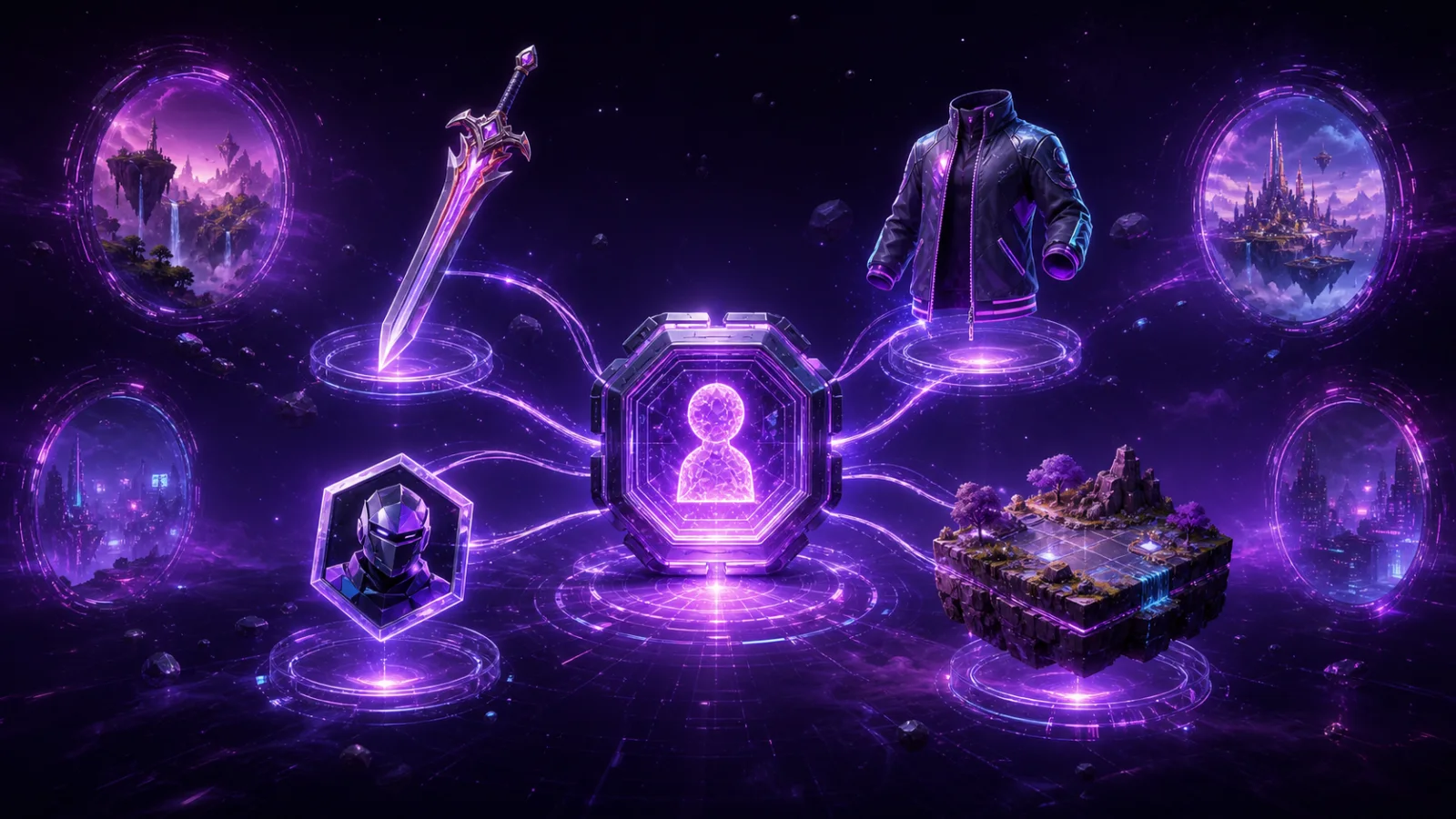
For decades, players have spent time and money earning skins, weapons, characters and virtual land without truly controlling them. The item may feel personal, scarce and valuable, but it usually remains an entry in a publisher-controlled database. It cannot leave the game, cannot be sold without permission and may disappear when an account is suspended or a server closes.
Player-owned asset economies change that relationship.
By representing a game item as a blockchain token, a game can give the player a verifiable claim that exists outside the studio’s private database. The player can hold the asset in a wallet, transfer it, list it on a compatible marketplace or use it in another application that recognizes the same contract and rights.
The important shift is not “putting NFTs into games.” It is turning digital items into durable economic objects.
What player ownership actually means
The phrase true ownership is often used too loosely. A player-owned asset should provide at least four properties:
- Verifiable possession. Anyone can confirm which wallet controls the token without asking the game studio.
- Transferability. The player can move or sell the item under clearly stated rules.
- Persistence. Ownership records do not depend on a single game database remaining online.
- Legible rights. The token, metadata and license explain what the player may actually do with the asset.
ERC-721 provides a standard interface for tracking and transferring unique assets. ERC-1155 lets one contract manage both fungible and non-fungible item types, including efficient batch transfers. Together, these standards make it possible for wallets, marketplaces and games to recognize the same assets without every integration starting from zero.
That does not mean the token automatically contains the sword, character or land itself. In most implementations, the token points to metadata, media and game logic stored elsewhere. Durable ownership therefore requires durable metadata, clear upgrade policies and a license that separates token possession from intellectual-property rights.
The market is real—and still volatile
The strongest signal is not a headline valuation. It is repeated on-chain use.
DappRadar’s State of Blockchain Gaming Q3 2025 recorded more than 4.66 million daily unique active wallets interacting with blockchain games. Gaming NFTs generated approximately $135 million in trading volume during the quarter, while blockchain gaming remained the largest Web3 product category by active-wallet share.
The broader trajectory is not a straight line. The same report showed active wallets declining quarter over quarter, and DappRadar’s 2024 overview reported both strong growth in on-chain activity and a 38% annual decline in gaming investment to $1.8 billion.
This tension matters. Player-owned markets are no longer a laboratory experiment, but the industry is moving away from speculative “play-to-earn” loops toward assets with genuine game utility. The next stage will be judged less by token prices and more by whether players want the item even when no financial reward is attached.
Why ownership changes game economics
Traditional game items are sold once. A player-owned item can participate in a longer economic lifecycle.
1. Primary sales become the beginning
A studio may sell or reward an asset, then continue supporting it through crafting, upgrades, repairs, personalization and new game integrations. The relationship becomes ongoing rather than transactional.
2. Secondary markets reveal real demand
Open trading allows price discovery. Players can exit an item they no longer want, collectors can seek specific editions and studios can observe which traits or histories the market values.
Standards such as ERC-2981 can signal a creator royalty on resale. However, the standard only communicates royalty information; marketplaces still choose whether to honor and pay it. A sustainable studio cannot assume royalties are guaranteed revenue.
3. Provenance creates a new form of rarity
Two assets with identical base statistics do not have to remain economically identical. One may have been used in a tournament final, carried by an early community member or earned during a limited event.
When that history is attestable, scarcity can emerge from deeds rather than artificial supply limits. This is the basis for living items: assets whose identity compounds through play.
4. Players become distribution partners
An item that can move across wallets and marketplaces carries the game’s identity into new communities. Owners create guides, collections, showcases and stories around assets they care about. The economy becomes a distribution surface, not merely a monetization feature.
Interoperability is a contract, not a magic portal
Owning an item does not mean every game must render or honor it. A realistic interoperability system separates several layers:
- Ownership interoperability: another application can verify that the player owns the asset.
- Identity interoperability: the item’s name, appearance, creator and history can be displayed elsewhere.
- Utility interoperability: another game intentionally maps the asset to local functionality.
- Economic interoperability: marketplaces, rentals, bundles and rewards can operate across multiple titles.
The host game must always protect its balance. A legendary sword from one title cannot import unlimited damage into another. The receiving game needs a normalization rule: preserve the item’s identity and provenance while translating its power into the host’s allowed range.
This is why shared trait schemas and explicit licenses matter more than vague promises of “use it everywhere.” The Sverse ecosystem is designed around progressive interoperability, so studios can begin with ownership and identity before adopting deeper cross-game utility.
The five design tests every studio should pass
A player-owned economy succeeds when the game remains worth playing without speculation. Before minting an item, a studio should answer five questions.
Is the asset desirable inside the game?
Ownership cannot rescue weak utility or weak art direction. The asset should have a reason to exist before it has a market.
Where does value leave the economy?
Markets need sinks: crafting, repairs, upgrades, entry fees, cosmetic transformation or other voluntary uses. If rewards only enter and nothing is consumed, inflation eventually overwhelms demand.
What rights travel with the token?
The studio should define transfer rights, commercial-use rights, metadata policies, moderation rules and what happens when the game sunsets. Players should not need to interpret marketing copy as a legal license.
Can a normal player use it safely?
Seed phrases, gas tokens and opaque signing prompts remain unacceptable onboarding for mainstream games. Email login, smart accounts, sponsored transactions and recovery mechanisms should make the wallet feel like invisible infrastructure. The goal of S-Passport is to give players one identity and inventory without forcing them to become security experts.
Does the economy resist extraction?
Bots, multi-account farming, wash trading and reward mercenaries can destroy a market that treats every wallet as a real player. Reputation, proof of play, rate limits and behavior-aware rewards are as important as the token contract.
What happens when a game shuts down?
This is the hardest test of ownership.
The token may remain in the player’s wallet, but the original game client, 3D model hosting or utility server may disappear. “The NFT survives” is only meaningful if its metadata, media, history and license remain accessible.
Responsible studios should publish a sunset policy before launch. That policy can include permanent metadata storage, open asset formats, community hosting rights, export tools and a final contract state that prevents unexpected administrative changes.
Ownership does not make software immortal. It gives players and communities better tools to preserve value when a product’s lifecycle ends.
From financialization to participation
The first generation of blockchain games often asked players to care about an economy before giving them a compelling game. The more durable model reverses the sequence:
play first, ownership second, markets third.
Players should discover ownership as a benefit of participation, not as a financial prerequisite. A cosmetic earned through skill, a character shaped by months of decisions or a creator-made item with transparent provenance can become valuable because it carries meaning.
This is also where communities matter. Programs such as ReadyPlayerS connect players, creators and studios around actual play and contribution rather than passive token holding.
The next competitive advantage for game studios
Player-owned assets will not replace every centralized inventory. Many quest items, temporary boosts and regulated rewards should remain non-transferable. The opportunity is selective ownership: tokenize the assets for which persistence, provenance, trading or portability creates more value than it introduces risk.
For a one-human studio, that choice can unlock capabilities once reserved for large publishers:
- a global settlement and resale layer;
- a portable player identity;
- creator royalties and community marketplaces;
- cross-game collaborations;
- collectible histories that deepen retention.
The winning economies will not be the ones with the most NFTs. They will be the ones where ownership makes the game more expressive, the market more transparent and the relationship between player and studio more durable.
For studios exploring this model, Sverse’s developer tools are built to make ownership optional and progressive—from simple SRV payments to living, interoperable assets. Follow Sverse News for further research on game distribution, digital ownership and the one-human studio economy.