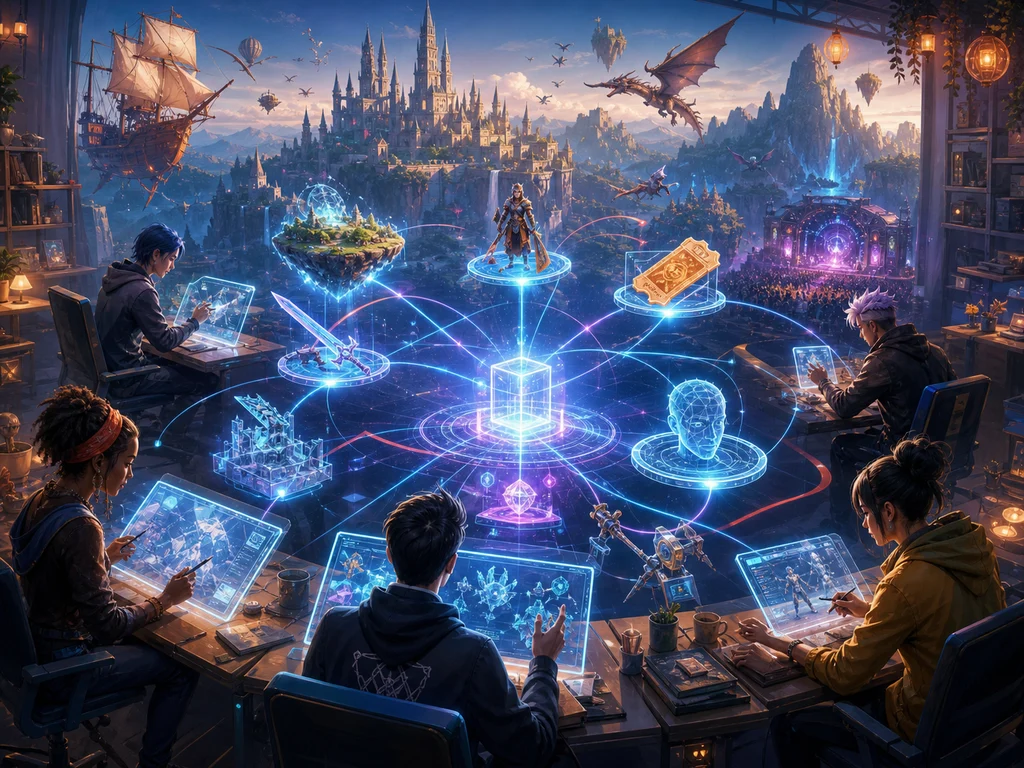
AI has sharply reduced the cost of making a game. A single creator can now use an agent, an engine and a weekend to build what once required a team and eighteen months.
But production was never the only bottleneck. Small studios still need distribution, payments, player identity, community operations, asset ownership and trust. Sverse is designed as the layer between those studios and a larger game economy.
The most important clarification comes first: Sverse is not GameFi. It is not a financial wrapper around a weak game, and it is not an emissions machine that prints rewards to keep a chart moving. Sverse is intended as an RWA platform for games: a system that makes rights, provenance, contributions and real-world relationships more verifiable, portable and useful.
What is Sverse?
Sverse is a game distribution and economic platform for the one-human studio: a studio that may have one person, but can use AI, SDKs and community tools to ship a real product.
The platform is organized around four connected surfaces:
- Sverse Store: distribution for games, item packs and digital products;
- Sverse Build: SDKs, APIs and AI tools for payments, inventory and provenance;
- Sverse Clubs: communities, reviews, quests and reputation around each game;
- S-Passport and Wardrobe: shared identity and inventory for assets that should travel between games.
The game remains the product. Blockchain and the token are infrastructure for settlement, ownership and history. A studio does not have to tokenize every item. Sverse’s Tokenization Ladder, from L0 to L5, is designed as a dial: a game can begin with simple payments and entitlements, then add provenance, resale or deeper on-chain ownership when players actually need those properties.
Why call it RWA for games?
In finance, real-world assets usually mean tokenized funds, credit, commodities or property. In games, the same principle can apply to a broader set of rights and relationships.
Examples include:
- a tournament ticket that unlocks a limited in-game experience;
- a physical collectible with a verifiable digital companion;
- a creator-made item with an auditable author, license and revenue history;
- a tournament or campus achievement that becomes a portable credential;
- an event, brand or community program that issues a digital asset with clear access rights.
These are not automatically securities, and they should not be marketed as guaranteed investments. They are game-linked rights, proofs and experiences that can be represented and verified more reliably than a private database entry.
Sverse’s RWA thesis is therefore not “put finance inside every game.” It is to make access, provenance, achievement, contribution and ownership legible across a connected ecosystem.
How Sverse works
1. A studio brings a product into the ecosystem
A creator can start with Unity, Godot or JavaScript. Sverse Build provides SDKs, a REST API and an MCP server that can help an AI agent inspect a project, propose an item catalog, map trait schemas, install integration and run a test purchase.
The goal is not to turn a game designer into a blockchain engineer. It is to shorten the path from repository to a product that can be sold, measured and updated.
2. Players buy and use the product
The checkout can show familiar fiat pricing while settlement happens through SRV behind the scenes. This preserves a normal player experience and creates token utility through real activity, instead of requiring every player to trade a token before playing.
S-Passport provides identity and inventory. Smart accounts, email login and gasless flows can hide much of the wallet complexity. When a product needs stronger ownership, an item can be minted to the Passport rather than remaining trapped in one game’s database.
3. Contribution creates new value
Contribution is not limited to buying tokens. A studio contributes a game, item pack, quest, event or community. A player contributes meaningful play, reviews, guides, referrals, moderation or user-generated content.
Sverse needs to measure these contributions through Proof-of-Play, reputation and quality signals—not by counting wallets. If a game has real players, real usage and products people want, it can create additional demand for the ecosystem.
4. Fees are distributed through a shared model
The current Sverse design describes protocol fees flowing to multiple groups: buyback and burn, creators, players, treasury and curators. The public landing page presents a reference split of 25% / 25% / 20% / 20% / 10%, with a possible fee reduction through staking.
These are design targets, not a promise of returns. The final fee split, staking rules, buyback policy, burn mechanism and governance must be documented, audited and reviewed for each relevant jurisdiction before launch.
What does the shared SRV token mean?
SRV can be understood as a common economic rail for many game products:
studios integrate → players buy and use products → fees are generated → creators and communities receive rewards → part of the value is burned or allocated to the treasury → the ecosystem gains more products and users.
When users buy SRV to access products in Sverse, demand for the token may increase. When studios contribute more games and applications, there are more reasons to use it. If that activity creates durable fees greater than the cost of operating the network, token utility can be supported by real economic activity.
Two statements must remain separate:
- Contributing products can create more demand to use SRV.
- Contributing products guarantees that the SRV price will rise.
The second statement cannot be guaranteed. Price also depends on liquidity, circulating supply, competition, regulation, market sentiment and the quality of the games. A healthy economy must remain useful even when users are not buying the token for speculation.
Why Sverse is not GameFi
GameFi usually puts financial incentives before the game: token farming, yield and emissions are the primary reason to participate. When the rewards fall, the players leave and the economy collapses.
Sverse is intended to reverse that order:
play first → product utility → clear rights → shared settlement → secondary markets when they are useful.
That means:
- a game should be enjoyable with simulated assets and test accounts;
- rewards should be a share of real fee revenue, not an unlimited emissions schedule;
- an item should be tokenized only when portability, provenance or resale adds value;
- an imported asset must not break the host game’s balance;
- a token must not replace game design, community trust or customer support.
The distinction is simple: GameFi asks a game to serve the token. Sverse asks the token to serve a network of games.
The main weaknesses and risks
Speculation and a self-referential loop
If people buy SRV only because they expect someone else to buy it later, the ecosystem becomes a speculative loop. The answer is to measure real fees, retention, quality playtime, active studios and non-speculative users—not only market capitalization.
Low-quality AI games
An open marketplace can fill with quickly generated games that have no lasting players. Sverse needs curation, Proof-of-Play, reputation-weighted reviews, Genesis Studio cohorts and clear removal rules. AI reduces production cost; it does not replace QA.
Bots, sybil accounts and wash trading
One person can control many wallets, trade with themselves or farm rewards. Reputation, rate limits, verified activity, skill-weighted distribution and mandatory sinks must be designed from the start. One wallet should never be treated as one real player by default.
Regulation and asset rights
A shared token can look like an investment contract if the marketing promises profit or a guaranteed buyback. Tickets, physical goods, creator revenue and commercial rights may also create specific legal obligations. Sverse needs market-by-market legal review, clear utility language, risk disclosures and a strict rule that a studio cannot tokenize rights it does not own.
Centralized power
If one team controls the treasury, listings, fee split and emissions, a “shared economy” is only a centralized platform with a token. Sverse needs transparent treasury reporting, multisig controls, admin limits, independent audits, delayed governance and regular disclosures.
Infrastructure and game shutdowns
An asset can remain in a wallet while its game server, metadata or studio disappears. Sverse needs a sunset policy, export formats, verifiable Deed Ledger history, migration paths and a community process for preserving valuable assets after a studio closes.
How investment funds can create trust
Sverse needs investment funds for more than token purchases. The more important role is creating verifiable trust between the platform and thousands of small studios.
A responsible ecosystem fund could:
- Finance milestones: fund prototypes, testnet, security review and launch through grants or revenue-based financing—not a cheque based only on a pitch deck.
- Subsidize hard infrastructure: help with servers, legal work, security, moderation and user research so a small studio is not forced to carry every risk alone.
- Build studio cohorts: give small teams shared SDK support, AI skills, QA, marketing and community playbooks.
- Publish due diligence: evaluate code, team, retention, IP rights, token exposure and operational capacity before introducing a product to the community.
- Report evidence: disclose active games, returning players, real fees, security incidents, disputes and the percentage of studios that remain active after six months.
The fund should not be a mechanism for artificially supporting a token price. Its job is to finance useful supply, reduce avoidable risk and make the network easier to trust.
A school of small fish
The long-term Sverse vision resembles a school of small fish. Each studio can experiment quickly. The failure of one game should not sink the entire ecosystem. Yet all of them can benefit from shared distribution, identity, settlement, discovery and community tools.
AI helps each small fish move faster. Investment funds provide safer water, specialist support and credibility. Sverse provides the current that connects them.
This structure also creates a healthier portfolio logic. The ecosystem does not need one studio to become a giant publisher. It needs many focused teams, each with a distinct audience, whose combined products create a larger and more resilient game economy.
The real goal
Sverse does not need to prove that a token can replace the game industry. It needs to prove something more practical: a small studio can make a game people want, retain ownership of what it builds, reach players without becoming a tenant of one platform and contribute to a shared economy without turning the game into a casino.
If the model works, SRV is not a reward for a promise. It is a settlement and coordination rail that lets useful products connect and share value. If the model fails, SRV becomes a self-referential token where everyone buys because they expect the next buyer to arrive.
That is why the most important Sverse metric is not market capitalization. It is the number of small games with real players, real creators, verifiable assets and communities that return. When those things grow, a shared economy has a foundation strong enough to matter.
Read more about the Sverse ecosystem, S-Passport, Sverse Build and the SRV token model.